A landmark clinical trial is testing whether we can reprogram aging eye cells back to health — opening a door that medicine has never opened before. By Arthur Benjamin, MD. Founder & Medical Director, Benjamin Eye Institute
For decades, a glaucoma or NAION diagnosis carried an unspoken truth: the vision you've lost is gone forever. That may be about to change — and the science behind it is unlike anything we have seen in my 25 years of practice.
At Benjamin Eye Institute, we care for a significant number of patients living with glaucoma and non-arteritic anterior ischemic optic neuropathy (NAION). These are conditions defined by the slow or sudden death of retinal ganglion cells — the neurons that form the optic nerve and carry everything you see to your brain. Once these cells die, no treatment has been able to bring them back. Until now, our entire field has focused on slowing the loss. A new therapy called ER-100 is aiming at something far more ambitious: actual recovery.
80M+
~30K
0
people worldwide living with glaucoma
new NAION cases in the US each year
approved treatments that restore lost RGC function (until now, potentially)
What Exactly Is ER-100?
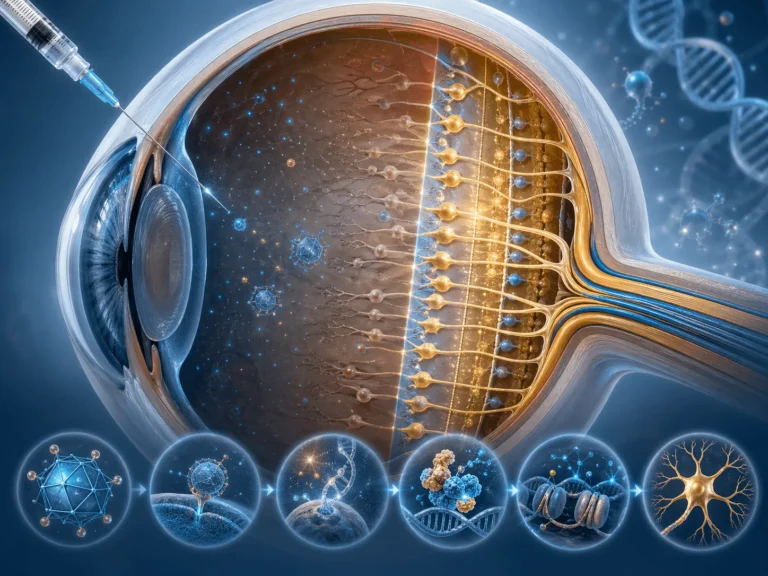
ER-100 is an investigational gene therapy developed by Life Biosciences. It is delivered as a single injection directly into the eye — the same kind of intravitreal injection we already use for conditions like macular degeneration — and it works through a concept called partial epigenetic reprogramming.
Your DNA doesn't change over your lifetime, but the instructions for how your cells read that DNA do. Epigenetic markers — chemical tags on the genome — accumulate errors as we age, causing cells to forget what they're supposed to do. They become less efficient, less resilient, and eventually die. ER-100 carries three transcription factors (OCT-4, SOX-2, and KLF-4, known collectively as OSK) that essentially reset those markers — restoring the cell closer to a youthful state without erasing its identity.
The word "partial" is critical here. Full reprogramming would turn a cell back into a stem cell — dangerous and uncontrolled. Partial reprogramming dials the clock back just enough to rejuvenate the cell while keeping it a retinal ganglion cell. And crucially, it is switched on and off by a course of oral doxycycline — an antibiotic most of us have taken at some point — giving researchers precise control over the process.
How the Treatment Works: Simply
A single intravitreal injection delivers the ER-100 gene therapy into your eye via a modified, harmless virus (AAV vector). The therapy sits dormant until you take doxycycline by mouth for 8 weeks — which activates the three reprogramming genes. Once the antibiotic course ends, the reprogramming switches off. The treated retinal ganglion cells are reset to a younger, healthier state.
The Evidence So Far
Before reaching human trials, ER-100 was tested in non-human primates with an experimentally induced NAION-like injury. The results were striking. The therapy significantly reduced deterioration in pattern electroretinogram responses — a direct measure of retinal ganglion cell electrical function — and improved axon density in both prevention and rescue models.
Perhaps most compelling was what happened at the molecular level: ER-100 restored the precise methylation patterns associated with neuronal regeneration. This wasn't just slowing damage. The cells were showing signs of biological renewal.
"For the first time in my career, I am watching a therapy aim not at halting decline, but at reversing it. That is a fundamentally different kind of medicine."
Arthur Benjamin, MD · Benjamin Eye Institute
The Phase 1 Clinical Trial
Following FDA clearance of its Investigational New Drug application, Life Biosciences launched a first-in-human Phase 1 study (NCT07290244) in early 2026. The trial enrolls two groups:
Open-Angle Glaucoma (OAG)
Patients receive ER-100 at escalating doses with careful monitoring by an independent Data Safety Monitoring Board between each cohort. The primary focus is safety and tolerability, but researchers are also tracking multiple measures of visual function.
NAION
This is where timing becomes critical. Eligible NAION participants must enroll within 14 days of vision loss onset, with confirmed optic disc swelling and visual field loss. This acute window reflects the biology — the sooner a rescue signal reaches those threatened cells, the better the chance of meaningful recovery. Patients are followed for up to five years.
This is a Phase 1 trial, meaning its primary purpose is to establish safety. We are not yet at the point of confirmed efficacy in humans. But the preclinical evidence is unusually strong, and the design — with long-term vision outcome tracking — means we will begin to see signals of functional recovery relatively early.
Why This Matters Far Beyond the Eye
Here is where the story becomes extraordinary — not just for our glaucoma and NAION patients, but for every person who will age.
The mechanism driving ER-100 — partial epigenetic reprogramming — targets what many scientists now believe is a root cause of aging itself. Cellular senescence, the state in which cells stop functioning and become toxic to surrounding tissue, is driven in large part by accumulated epigenetic errors. By resetting those errors, therapies in this class have the theoretical potential not just to treat disease, but to slow or reverse aspects of biological aging at the cellular level.
The eye is the ideal proving ground. We can measure retinal function with extraordinary precision using electroretinography and OCT imaging. We can deliver therapy locally, minimizing systemic risk. And we can see functional outcomes — literally. If epigenetic reprogramming works here, it opens the door to its application in the brain, the heart, the kidneys, and beyond.
Life Biosciences has described ER-100 as the first step in a broader cellular rejuvenation platform. The scientists who developed this approach include some of the most prominent figures in aging biology. The implications, if the safety and efficacy data hold in humans, are difficult to overstate.
A Note on Realistic Expectations
As your physicians, we want to be honest with you: ER-100 is not yet an available treatment. Phase 1 trials are the earliest stage of human testing, and the path from promising science to an approved therapy typically takes years. Our enthusiasm is genuine — but so is our commitment to evidence. We will be watching this trial closely, and we will keep you informed as results emerge.
What You Should Do Right Now
If you have been diagnosed with glaucoma or have experienced a sudden, painless loss of vision that may represent NAION, the most important thing you can do is maintain consistent care. For glaucoma, controlling intraocular pressure and protecting the remaining nerve fiber layer remains the standard of care — and the more nerve tissue that survives to be treated, the greater the potential benefit of any future regenerative therapy. For NAION, if a new episode occurs, contact us immediately. The 14-day enrollment window for this trial moves very quickly.
At Benjamin Eye Institute, we are committed to staying at the leading edge of what is possible for your vision. Therapies like ER-100 represent the future we have been working toward — a future where optic nerve damage is not a sentence, but a condition we can actually treat.
Stay Informed. Stay Ahead
Schedule a consultation with Dr. Benjamin to discuss your optic nerve health and what emerging therapies may mean for your care.
Call or text 310.275.5533